Booking choice: The Geiranger sightseeing cruise, from $73 per person. Check dates Tour details
The rule took effect on 1 January 2026 after years of preparation. The Norwegian Maritime Authority adopted it in April 2025 on behalf of the Ministry of Climate and Environment, and the work behind it started in 2018.
For a visitor the effect is simple: the small boats on the Geirangerfjord are getting quieter, and some old ones are on borrowed time. The big ships stay as they are until 2032.
The quick answer
From 1 January 2026, passenger ships under 10,000 gross tonnes must use energy that emits no CO2 or methane while sailing in the World Heritage fjords: the Geirangerfjord, the Sunnylvsfjord, the Tafjord, the Nærøyfjord and the Aurlandsfjord. Ships of 10,000 gross tonnes and above follow from 1 January 2032. There are time-limited exemptions, and the old Hellesylt car ferries ran on one in 2026.
What does the zero-emission rule say?
Passenger ships under 10,000 GT in the World Heritage fjords must sail on energy with no direct CO2 or methane emissions from 1 January 2026. Bigger ships follow on 1 January 2032.
The text sits in the Norwegian regulations on environmental safety for ships. It is technology-neutral: batteries, hydrogen and similar fuels all count, as long as nothing climate-warming comes out of the stack while the ship is in the fjord. Ships must also use shore power wherever a quay offers it. The full wording is on the Norwegian Maritime Authority's site.
Biogas is the one combustion fuel allowed, with strings attached. It has to be kept apart from fossil fuel until bunkering, loaded within the last month before the ship enters the fjords, and match the amount the ship will burn there. Grid gas backed only by a certificate does not qualify. The aim is plain: no paper tricks.
| Who | Zero-emission from | What you will see |
|---|---|---|
| Passenger ships under 10,000 GT (sightseeing boats, small ferries, small expedition ships) | 1 January 2026 | Electric and hybrid boats, battery-only legs |
| Passenger ships of 10,000 GT and up (big cruise ships) | 1 January 2032 | No change yet; speed and noise rules apply |
| Small ships without shore power that sailed here in 2024 | Exemption up to two years at a time, never past 31 December 2029 | Older boats still in service |
| County fast boats on public contracts | Exempt | Local scheduled routes |
| Ships with official heritage status | Can apply for exemption | Classic ferries |
Which fjords are covered?
The two World Heritage areas: the Geirangerfjord with the Sunnylvsfjord and the Tafjord, and the Nærøyfjord with the Aurlandsfjord.
UNESCO listed the West Norwegian Fjords in 2005 as one site in two parts, about 120 km apart. The rule follows those boundaries, so the whole run from Hellesylt to Geiranger is inside it. The Storfjord, which the Ålesund boat sails for most of its three hours, is outside.
That is why the Ålesund boat runs on its engines for most of the way and switches to battery power for the last 40 minutes into Geiranger. It is also why some cruise lines started looking at Eidsdal, a port on the Norddalsfjord outside the protected area, according to a July 2025 report in the Norwegian engineering weekly Teknisk Ukeblad. If you want the comparison with the other World Heritage fjord, read Geirangerfjord or Nærøyfjord.
What does the rule mean for the boat you book?
Quieter boats. The 2-hour silent cruise and the last 40 minutes of the Ålesund boat run on electric power, and you can hear the waterfalls instead of an engine.
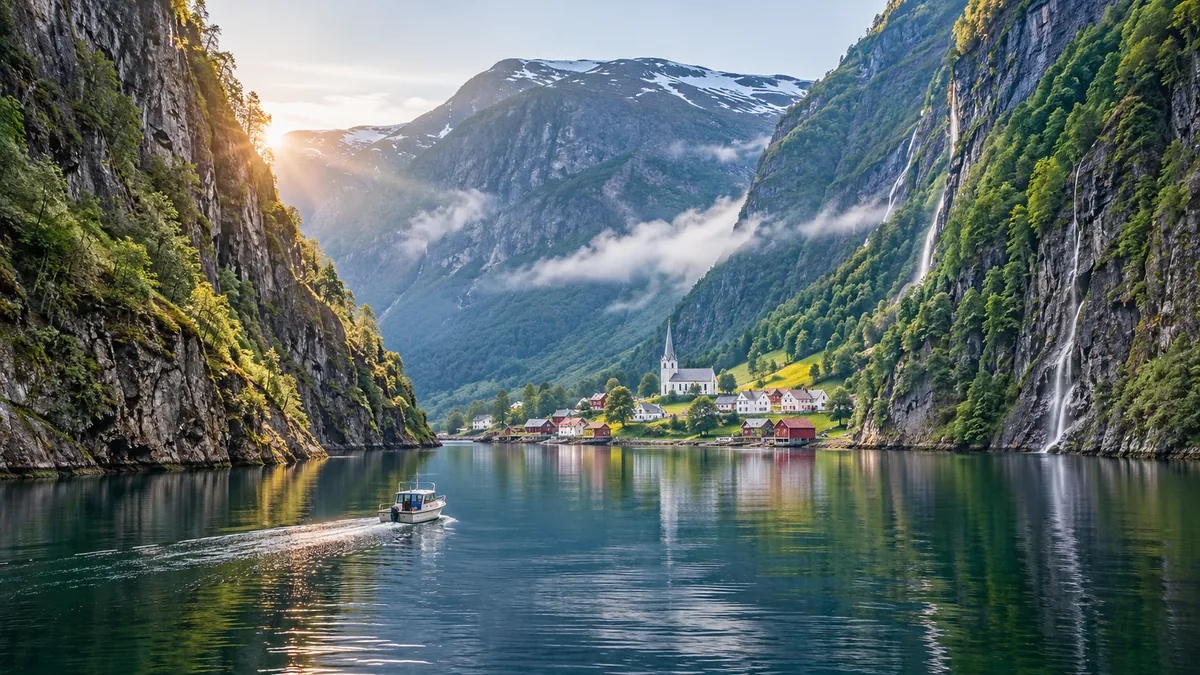
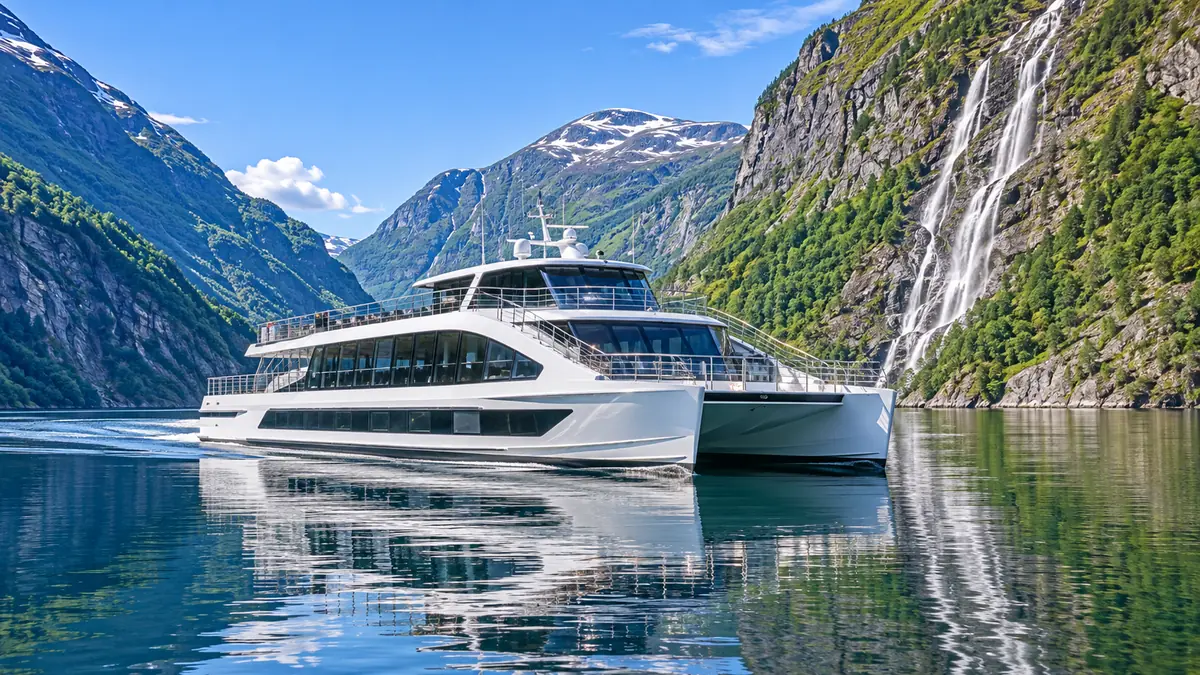
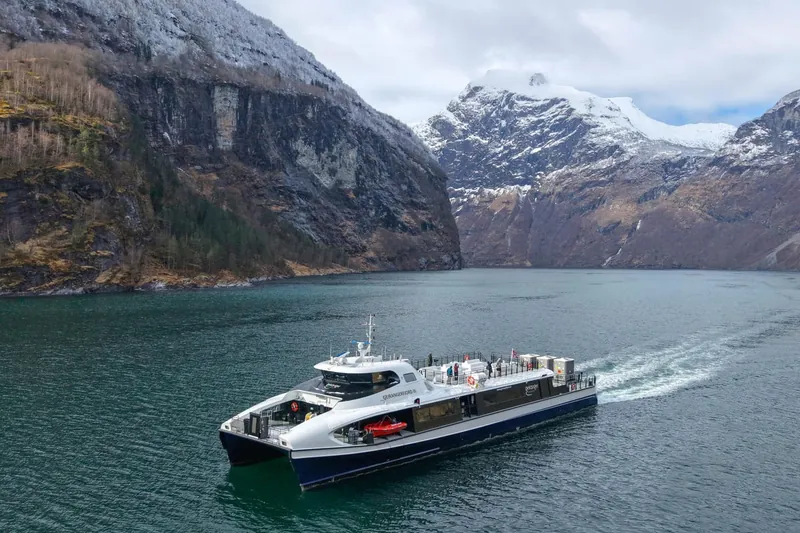
The Geiranger sightseeing cruise offers two boats: a 75-minute trip on the traditional vessel, or 2 hours on a hybrid-electric catamaran that the operator sells as the silent cruise. Their newest boat, Geirangerfjord III, is a 46-metre carbon-fibre hybrid for up to 280 guests. The Ålesund boat is a hybrid too, and the listing promises "40 silent, battery-only minutes" inside the Geirangerfjord.
Every passenger boat on the fjord under 10,000 GT falls under the same rule, the RIBs and the Hellesylt boats included, unless it holds one of the time-limited exemptions. For you, nothing changes at the ticket desk. You still book a time, show your QR code and choose your seat on board. What changes is the sound. On a silent stretch, the Seven Sisters are louder than the boat.
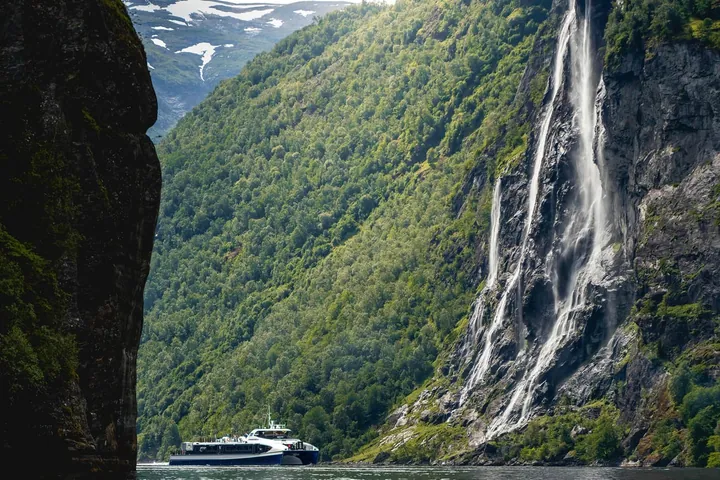
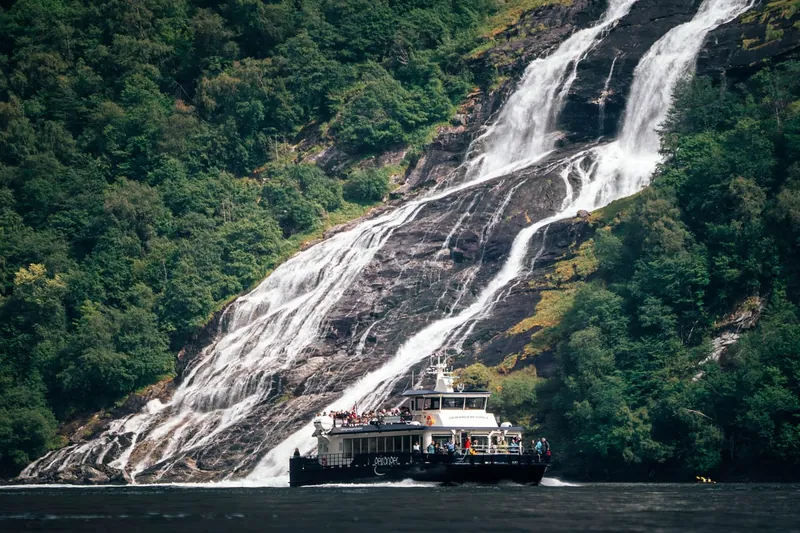
Pick the 2-hour departure for the silent hybrid catamaran and the full 16 km of fjord out to the inlet.
Explore the Geiranger sightseeing cruise Tour detailsWhy was the Hellesylt ferry affected?
Its older car ferries cannot meet the rule, so Fjord1 sailed the 2026 season on a temporary dispensation. A permanent exemption was refused.
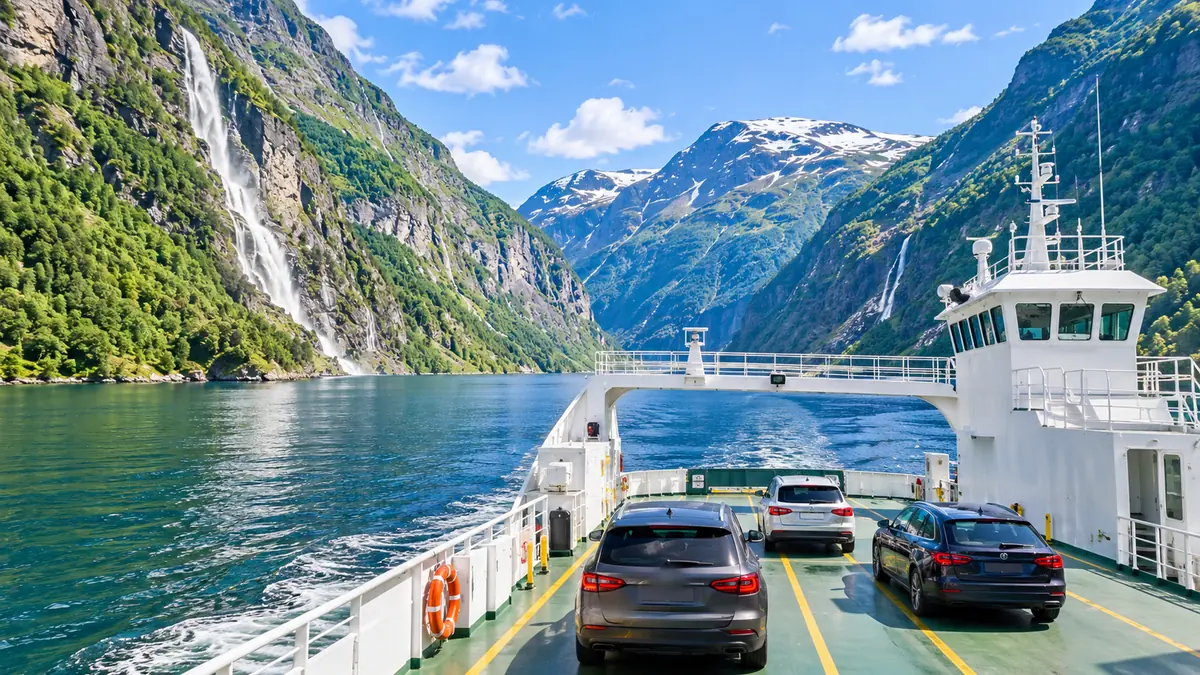
The Geiranger-Hellesylt crossing is the busiest route through the fjord, and it used classic diesel car ferries. In April 2026 the Maritime Authority refused a permanent exemption for the protected ferries on the route and gave a temporary one. Later it let Fjord1's MF Bolsøy and MF Veøy sail until 31 October 2026, with two ships a day in June, July and August.
After that, Fjord1 marked the route as suspended until further notice. The other operator, Vestlandske, sells through The Fjords and is converting two ferries, Jotunheim and Hjørungavåg, to battery operation with about 17 MWh of batteries, according to the trade site Shippax. Its booking page still says the new electric ferries are under construction. The practical answer for 2027 is in our season post.
What about the big cruise ships before 2032?
They keep calling. Ships of 10,000 GT and over have until 1 January 2032, but they already face speed limits, noise rules and a daily passenger cap.
The Geiranger port rules for 2026 set 8 knots in the inner fjord and 5 knots near the cruise anchorage, ban incinerators and discharges, and allow ship whistles and pool music only between 08:00 and 18:00. From 20 June to 10 August the port caps arrivals at about 6,000 cruise passengers a day. The Geirangerfjord has had stricter environmental rules since 2019, and the NOx limits were tightened in January 2025.
A big ship gives you the fjord from high up, once, at a steady pace. A local boat slows down beside the Seven Sisters and the Suitor and tells you about Skageflå and Knivsflå, the farms on the ledges. Cruise passengers tend to combine both, and the local boat is where the zero-emission rule is already visible. Our Seven Sisters guide covers what you see on the way.
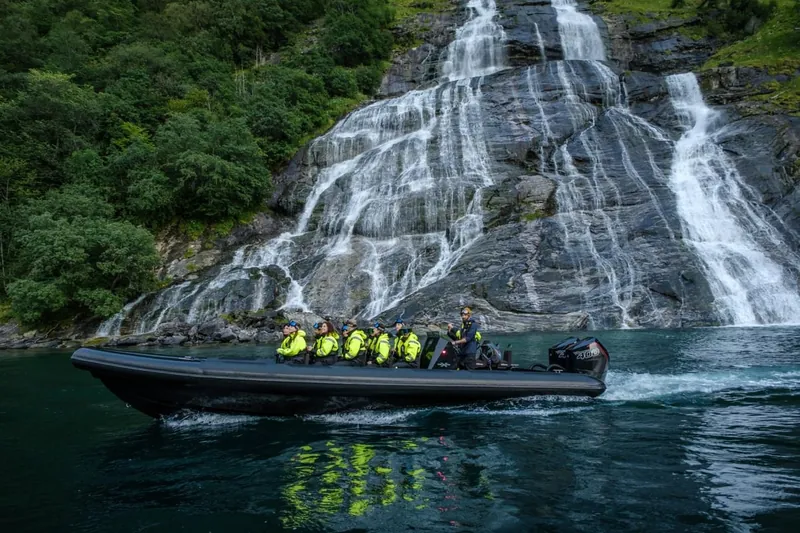
The fastest way to the spray: an open RIB from Geiranger, suits and goggles on, about 45 minutes on the water.
Check dates for the Geiranger RIB safariFrequently asked questions
When did the zero-emission rule start in the Geirangerfjord?
On 1 January 2026 for passenger ships under 10,000 gross tonnes. Ships of 10,000 gross tonnes and above follow on 1 January 2032.
Are the Geiranger sightseeing boats electric?
The 2-hour silent cruise runs on a hybrid-electric catamaran, and the Ålesund boat sails its last 40 minutes on battery power only. The 75-minute trip uses the traditional vessel.
Does the rule apply to cruise ships?
Small expedition ships under 10,000 GT since 2026. Big cruise ships from 1 January 2032. Until then they follow the port's speed, noise and discharge rules.
Which fjords have the zero-emission requirement?
The Geirangerfjord, the Sunnylvsfjord and the Tafjord in Møre og Romsdal, and the Nærøyfjord and the Aurlandsfjord in Vestland.
Ready to book
Choose your boat
Free cancellation up to 24 hours before on every option. Prices are from-prices in USD and move with the season.
Geirangerfjord Sightseeing Cruise
- Sightseeing cruise of 75 minutes or 2 hours
- Seven Sisters, the Suitor and the Bridal Veil up close
- Audio guide app in 12 languages
Ålesund to Geirangerfjord Boat Cruise
- Return boat ticket Ålesund to Geiranger
- 40 silent minutes on battery power in the Geirangerfjord
- 3 to 4 hours of free time in Geiranger
RIB Fjord Safari from Geiranger
An open speedboat, goggles on, right into the waterfall spray